 Convexfinance
 cvxCRV separates irreversible CRV conversion from market exits
Convexfinance cvxCRV represents CRV committed to Convex's vote-escrowed CRV (veCRV) position, with exits into CRV dependent on market liquidity. Converting CRV creates cvxCRV; staking makes that position eligible for rewards. Unstaking returns cvxCRV rather than reversing the conversion. A market swap can return CRV when suitable liquidity exists, but the amount follows the executable quote. The base issuance ratio does not establish a guaranteed resale price or a future redemption date.
Unstaking releases cvxCRV, while recovering CRV requires a market trade whose proceeds depend on available liquidity and execution terms.
Choose between fresh conversion and a market purchase
Fresh conversion commits additional CRV to Convex, while buying existing cvxCRV transfers tokens that someone else already holds. Both paths can supply cvxCRV for staking. Their acquisition terms differ: conversion follows the depositor mechanism, and a purchase follows market pricing. Compare the actual cvxCRV received for the same CRV input, including applicable transaction costs. An available market quote may offer different terms from conversion, without changing the token's underlying redemption limits.
Keeping CRV unconverted preserves the ability to hold or transfer that CRV directly. Once conversion succeeds, leaving cvxCRV unstaked does not restore that option.
Does the underlying CRV become redeemable later?
No, cvxCRV has no scheduled holder redemption into the underlying CRV through the conversion mechanism. Convex maintains the CRV commitment within its veCRV position. A lock timestamp associated with that position is not a personal maturity date for each cvxCRV holder. Selling the token transfers exposure to another holder; it does not release a corresponding deposit from the platform.
Converting CRV into cvxCRV through Convex is irreversible. The base issuance relationship is 1:1, although direct depositor calls can involve locking-incentive accounting. A deferred-lock deposit can allocate part of its amount to that incentive, while an immediate-lock call can receive accumulated incentives. These execution details concern the conversion amount, not a right to redeem later.
| Parameter | Value or behavior | Applies to | Limit or outcome |
|---|---|---|---|
| Base issuance ratio | 1 cvxCRV per CRV | Tokenized CRV deposits | Direct depositor incentive accounting can affect the amount received |
| Reverse conversion | No holder redemption into CRV | CRV committed through conversion | No scheduled redemption date |
| Wrapper withdrawal asset | cvxCRV | Withdrawal from the cvxCRV staking wrapper | CRV requires a separate exchange |
| Wrapper withdrawal timelock | No elapsed-time requirement in the withdrawal function | The cvxCRV staking wrapper | Withdrawal still requires sufficient balance and successful contract execution |
| Swap output floor | The minimum output specified for the exchange | A swap contract that enforces that parameter | The exchange reverts if execution cannot meet the minimum |
| Conversion terms, staking withdrawal, and market execution govern different parts of the position; none creates guaranteed CRV redemption. | |||
Unstaking releases cvxCRV from its reward position
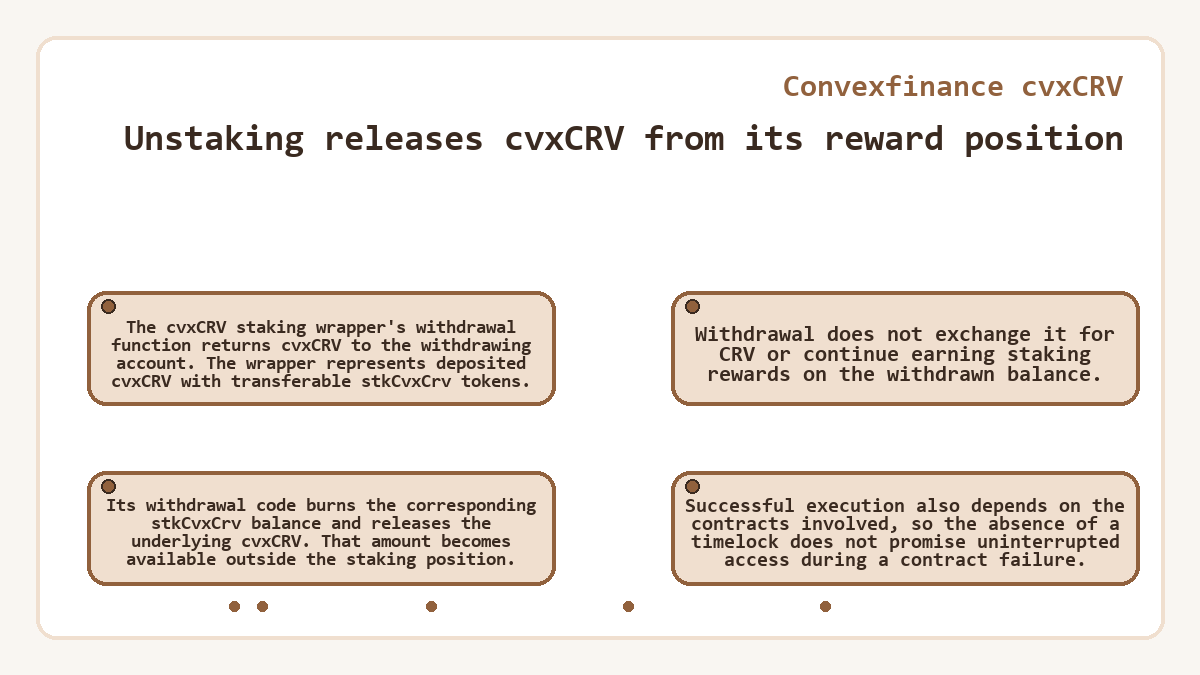
The cvxCRV staking wrapper's withdrawal function returns cvxCRV to the withdrawing account. The wrapper represents deposited cvxCRV with transferable stkCvxCrv tokens. Its withdrawal code burns the corresponding stkCvxCrv balance and releases the underlying cvxCRV. That amount becomes available outside the staking position. Withdrawal does not exchange it for CRV or continue earning staking rewards on the withdrawn balance. Successful execution also depends on the contracts involved, so the absence of a timelock does not promise uninterrupted access during a contract failure.
What determines how much CRV an exit returns?
A cvxCRV sale returns the CRV that its selected market can deliver for the submitted amount, after the exchange's applicable fees and subject to its execution limits. Available liquidity and pool balances affect that output. A displayed token price cannot describe every trade size, and a quote can change before execution.
The quote must match the intended sale amount
Compare CRV received with cvxCRV spent to express the effective exchange ratio. Keep network costs separate unless both figures use the same valuation basis. The relevant quote uses the intended sale amount; scaling a small quote proportionally can misstate proceeds when a larger trade moves the pool price.
Price impact changes the terms within the trade
Price impact is the change attributable to the trade itself. Selling into limited liquidity can produce a worse average exchange ratio as the amount grows. A cvxCRV discount also means that its market value is below the base issuance relationship. Buying at that discount does not create a guaranteed conversion profit because holders cannot redeem through the reverse path.
Slippage limits constrain execution after the quote
A minimum-output setting limits how little CRV the swap may return. Price movement between quoting and execution can make that condition fail. Increasing the permitted slippage accepts a lower output; it does not improve liquidity or repair the quoted exchange ratio.
The amount received in a completed swap settles the exit. Expected future rewards cannot substitute for CRV absent from that transaction.
A minimum-output failure leaves the swap unfilled
An exchange that reverts because its minimum output cannot be met has not completed the cvxCRV sale. The failed swap's token changes roll back, although an included transaction still incurs gas costs. A previously completed, separate unstaking transaction remains effective. This distinction explains why cvxCRV may sit in the wallet after an unsuccessful attempt to exit into CRV.
A fresh quote for the same tokens and amount is a read-only check of the available terms. It shows whether the current quoted output meets the intended minimum, but does not guarantee the output at execution. Retrying requires acceptable execution terms; submitting the same failed assumptions again does not improve them. An allowance or insufficient-balance error needs its own correction and provides no reason to relax the output floor.
Staking rewards do not establish an exit price
Staked cvxCRV can receive Curve fee rewards in crvUSD, alongside eligible CRV and CVX rewards. Reward preferences affect participation in those distributions, while changing emissions, fees, and token values affect their worth. Vote locking CVX is a separate governance position. Neither its schedule nor cvxCRV's reward accrual provides a redemption mechanism for the converted principal. Accumulated rewards may offset some economic losses, but they cannot require a market to purchase cvxCRV at its issuance ratio.
Convexfinance cvxCRV: frequently asked questions
Does approving CRV already commit it to cvxCRV conversion?
Approval authorizes a contract to spend CRV; conversion occurs through a separate contract action. A successful approval alone does not mint cvxCRV or establish a staking position. Revoking an allowance changes spending permission, but it cannot reverse a conversion that has already executed.
Can only part of a cvxCRV stake be withdrawn?
The cvxCRV staking wrapper accepts a withdrawal amount, allowing a partial withdrawal within the account's balance. The withdrawn portion returns as cvxCRV, while the remaining portion stays in the wrapper. A later sale applies to the amount actually exchanged, so a partial withdrawal does not require selling the entire position.
Are Convex performance fees a deduction from every cvxCRV exit?
The performance fee on Curve LP CRV earnings is separate from selling cvxCRV. Part of that revenue supports cvxCRV staking rewards; it is not a universal percentage haircut on an exit's principal. A market exit instead has the exchange's applicable fees, price impact, and network transaction costs.
What happens to accrued rewards when a staked cvxCRV wrapper token is transferred?
The cvxCRV wrapper checkpoints rewards for the sender and recipient when its tokens move. Rewards accrued to the sender remain recorded for that account, while the transferred balance changes future reward participation. Transferring a wrapper token therefore does not automatically transfer the sender's already accrued rewards or convert the stake into CRV.
How can CRV arrive from a claim without any cvxCRV being sold?
CRV is one of the rewards that eligible cvxCRV staking positions can earn. Receiving it through a reward claim does not show that the converted principal was redeemed. The claim pays accrued rewards; a market sale separately exchanges cvxCRV for CRV and consumes the amount sold.